Celtic brooches
 Buy Celtic brooches from the Pera Peris range.
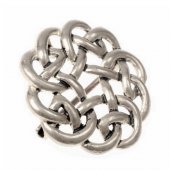 To this day, the fascination with the Celts remains undiminished. The demand for Celtic jewellery is therefore high, and such jewellery can be found everywhere in varying degrees of quality, from supposedly typical Celtic earrings or bracelets with knotwork ornamentation to authentic and detailed replicas of Celtic brooches.
The jewellery range at Pera Peris – House of History also includes a wide selection of Celtic jewellery, such as finger rings, earrings and bangles, as well as detailed garment clasps, Celtic brooches and torques based on historical models, made from high-quality cast bronze or genuine silver-plated.
The Celtic brooches available here are made from high-quality jewellery bronze in an elegant yellow gold alloy, and we also offer these garment clasps in genuine silver-plated versions, which are coated with an extra-thick layer of silver of up to 10 mg.
In addition, many of our Celtic brooches are often provided with professional tarnish protection, which prevents the surface from oxidising – so there is no need to worry about green or black discolouration, and the metal does not darken, but always remains beautiful and shiny.
 Celtic jewellery from the La Tène period
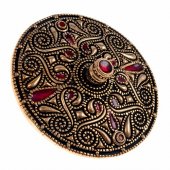 Jewellery from the La Tène period is characterised above all by an abundance of distinctive brooches, belt hooks, finger rings and glass arm rings. An important feature of La Tène culture is the rich ornamentation and, in some cases, figurative decoration of weapons, jewellery and metal vessels.
The craftsmanship of the La Tène period is particularly represented by belt hooks, which are often designed in the shape of animal heads. These are accompanied by characteristic curved rings or rings designed with bumps or bowl-shaped end knobs. In addition to arm rings, often made of yellow or blue glass, there are also filigree bronze chains whose rings are connected by special intermediate links.
The Celtic neck ring, known as a torque, should also be mentioned, which, like other jewellery, expressed rank and status within Celtic society. The ornamentation of that period consisted mainly of sinuous lines, dominated by the triquetrum and the spiral, often with inlays of enamel or blood glass. Coral and amber were also common.
Bronze was mainly used as the base material, but silver and, very rarely, gold were also used. However, silver was originally little used by the Celts and it was not until the late La Tène period that silver gradually found its way into Celtic culture in the form of coins. Instead, bronze was used to make jewellery.
The most important Celtic jewellery, however, were garment clasps, which also had an important practical function. Depending on the region and period, these so-called fibulae could have different shapes.
With the beginning of the Bronze Age, after the initial use of garment pins, the use of bronze garment clasps also began among the Celtic peoples. And so bronze fibulae were already in use in the Hallstatt period.
 Types of Celtic brooches
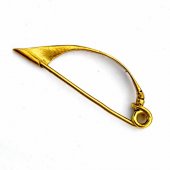 Even before the Hallstatt period began, one of the first examples was the violin bow brooch, which is considered one of the oldest types of brooch and is also known as the Peschiera brooch after the site where it was found in northern Italy.
The simplest form is a bronze wire needle rolled into a bow or a spiral at one end with a bent pin holder on the opposite side, which is similar to the safety pin we still use today.
Very similar to the violin bow brooch was the bow brooch, which was used by the Celts of the Hallstatt period from the Bronze Age to the early Iron Age. However, this was characterised by a strongly curved bow that stretched over the pin in an arc shape.
A rather unusual brooch is the snake brooch, which is a variant of the violin bow brooch and has a rather strange, twisted bow. Alongside the spiral brooch and the boat brooch, this garment clasp was widespread in Central Europe during the early Hallstatt period around 600 BC.
Dring the early Hallstatt period, however, the so-called boat brooch became particularly widespread in the Alpine region. This is actually a bow brooch with a greatly widened clasp and looks a little like an upside-down boat.
The kettle fibula, on the other hand, was particularly widespread at the end of the Hallstatt period around 500 BC and is a kind of further development of the boat fibula, in which the bow of the fibula was shaped like a kettle.
The foot fibula was a form of crossbow fibula and dates back to the end of the Hallstatt period. As its name suggests, it was characterised by a distinctive brooch foot, which was often decorated with spiral motifs.
During the La Tène period, artistic tastes in Celtic settlements changed due to external influences, particularly from the Mediterranean regions, and so brooch fashions also changed and new forms emerged.
The Certosa brooch, for example, was a further development of the violin bow brooch, which marked the transition from the Hallstatt period to the La Tène period in the 6th to 5th centuries BC. It was widespread in Italy and the south-eastern Alpine region as far as the Balkans.
A special form of the Certosa brooch was the bird's head brooch or swan neck brooch, which appeared between 400 and 300 BC and featured a backward-facing bow end shaped like a bird's head. The bow could be slender like a swan's neck or thickened like a duck's neck.
The relatively simple Certosa brooch developed in the 5th century BC in the Gallic regions into the so-called La Tène brooches, the younger examples of which were found not only in the Alpine region, but also in northern Germany and Scandinavia.
The brooches of the late La Tène period from 150 BC to the turn of the era were particularly diverse in design and could be long and delicate or broad and solid.
In the early La Tène period, mask brooches were also widespread, which usually had a rather elaborate bow in the shape of mask-like faces or grimaces, often combining animal and human figures.
Another representative of brooches from the late La Tène period was the crossbow brooch, which was essentially a further development of the Certosa brooch. In contrast to the latter, the crossbow brooch had additional arms around which spirals with up to ten turns wound on both sides, giving the brooch the appearance of a crossbow.
The crossbow brooch was originally particularly common in the southern Alps and spread from there to the western Balkans and south-western Pannonia. Crossbow brooches have even been found on the Rhine and in free Germania.
In the last century BC, the once powerful tribal areas of the Celts were increasingly threatened by the Romans and Germanic tribes, and it was during this period that a new brooch appeared, known as the curved brooch, which coincided with Caesar's Gallic War and the collapse of the Celtic Oppida culture between 80 and 40 BC.
This brooch marked the end of the arsenal of Celtic dress fasteners, and the brooches of the Roman Empire became the dominant finds.
We hope you enjoyed this little excursion into the world of ancient fibulae and that you will find a suitable brooch or pin for yourself in our online shop.


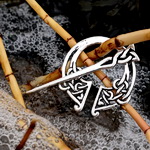 Here you can buy authentic replicas of Celtic brooches, which are made of high-quality bronze casting and are also available in real silver. In ancient times, brooches and cloak clasps, so called fibulae, were an indispensable part of the Celtic garb and a daily used, personal jewellery. Even today, these beautiful fibula replicas are ideal for Celtic re-enactment and a beautiful accessory for everyday life. Perhaps you too will find a Celtic brooch from our range here, whether as a stylish piece of jewellery for everyday life or for authentic historical outfitting.


