Everything you ever wanted to know about medieval knives...
 Medieval knives in the Pera Peris range – House of History
In Pera Peris' medieval shop, you can buy detailed replicas of historical medieval knives, which are carefully handcrafted based on models from the early and late Middle Ages.
Like the original medieval knives, our replicas have handles made of wood, horn or bone and brass fittings, and are fitted with high-quality carbon steel blades.
Each of our medieval knives comes with a sturdy sheath made of high-quality leather, some of which are decorated with decorative embossing in the style of the Middle Ages.
In addition to complete medieval knives, you can also purchase individual knife blades or entire knife kits and use them to make your own medieval knife according to your own ideas.
 Basic information about medieval knives
In the Middle Ages, simple knives for everyday use were the minimum personal equipment and an indispensable part of traditional costume. Knives were therefore carried by both men and women.
The typical medieval knife was a simple multi-purpose knife, which eventually developed into a table knife during the Renaissance.
The blades of medieval knives were usually no longer than 10 cm, but they could also reach lengths of 15 to 20 cm.
In addition to the typical knives for household, craft and kitchen use, folding knives were also used in the Middle Ages. These were already in use during the Roman era and also by the Vikings.
 The handles of medieval knives
Medieval knives could be either knives with a so-called handle tang, where the handle was attached to the tang of the blade, or knives with handle scales, where the handle was riveted to the side of the knife blade. However, these knives only became more widespread in the late Middle Ages.
Medieval knives with full tangs came in various forms:
- Medieval knives with a simple, attached full handle made of wood, horn or bone
- Medieval knives with a reinforced bolster at the base of the tang or the end of the handle.
- Medieval knives with a handle reinforced with copper or iron plates.
- Medieval knives with a metal sheath at the front end of the handle.
In contrast, there were only two types of knives with handle scales in the Middle Ages:
- Medieval knives with simple handle scales made of horn, bone or wood.
- Medieval knives with separately secured handle scales.
Until the beginning of the High Middle Ages, knives with tangs were the most common type of knife. It was not until the 10th century that medieval knives with handle scales became more common, eventually reaching greater popularity in the 12th century, until the number of these knives in archaeological finds nearly doubled in the 13th and 14th centuries.
 The blades of medieval knives
Medieval knives could have very different blade shapes depending on the era, fashion and area of application. From the 8th to the 12th century, knives with a straight back and a convex curved edge were very widespread.
Medieval knives with a curved back and straight edge, which were also common, declined somewhat from the 8th to the 10th century, only to enjoy renewed popularity in the 13th and 14th centuries.
However, medieval knives with a curved back and straight edge were very common throughout the Middle Ages and can be found in almost all Central European regions.
 Handle decorations on medieval knives
In the Middle Ages, sculpted decorations on knife handles were found almost exclusively on the solid handles of knives with tangs and were usually located at the end of the handle.
While abstract animal representations were preferred as handle decorations at the beginning of the Middle Ages, themes from the courtly sphere increasingly found their way into handle design from the 13th and 14th centuries onwards.
Medieval knives with designs such as knight representations or sculptures of court ladies etc. probably belonged to the higher classes.
In contrast to fully sculpted knife handles, simple, two-dimensional handle decorations were much more common on medieval knives.
These decorations were applied to both full-tang knives and handle-shell knives and were designed in particular as linear and geometric patterns.
Decorations in the form of braided bands, wave bands and ring chains were particularly common on medieval knives from the 9th to 12th centuries in the West Slavic region
With the increase in West German settlement activity in the course of eastward colonisation, these design forms gradually disappeared from the finds of medieval knives.
Circular eye decorations were also common on many medieval knives. The so-called dot pattern (circle pattern), which was largely limited to West Slavic settlements before 1300, can still be found in other regions as a decoration on medieval knife handles until the 16th century.
 Medieval knives with handle plates
In addition to simple solid handles, knives in the Middle Ages were often also fitted with elaborately crafted handles with so-called handle plate decorations
These medieval knives featured one or more thin discs as decorative elements between the solid handle parts made of wood, horn or bone. These handle plates were usually made of iron, bronze or brass sheet metal, but plates made of horn, bone and even leather were also used.
Medieval knives with handle plates made of non-ferrous metal were widespread from the 12th to the 15th century, but were rarely found before 1400 AD. They were found frequently in the north-eastern region, possibly due to the development of Hanseatic activity there. Decorations on medieval knives
 Blade decorations on medieval knives
From the 9th to 10th centuries, blade decorations began to appear sporadically on medieval knives, which could be applied to both the back and the front of the knife blade. However, such decorations only became common from the 16th century onwards.
Occasionally, so-called marks, i.e. stamped manufacturer's marks, were also applied to the front of the blade of medieval knives, with the oldest example of such a medieval knife dating back to the 13th century. Interestingly, this corresponds to the first written evidence of the knife-making profession.
 What types of knives can you still buy at Pera Peris?
We hope we have been able to give you a brief overview of medieval knives and would be delighted if you could find a suitable knife for your medieval re-enactment in our online shop.
In addition to medieval knives, you can also buy various other types of knives in other categories of our shop.
In the Iron Age Knives category, you will find hand-forged knives made by hand from a single piece of metal, based on models from the Celtic and Germanic Iron Age.
In the Early Medieval Knives category, you will find a selection of early medieval knives with simple wooden handles and leather sheaths.
In addition, in the Viking knives category, you can purchase a beautiful assortment of historical knives based on models from the Viking Age, including knife blades made of Damascus steel and leather sheaths with metal fittings.
If you don't want a ready-made knife, you can of course simply buy a knife blade and build your own knife using the handle materials we offer.
We also offer complete knife kits for this purpose, including knife blade, handle material, leather sheath and assembly instructions.


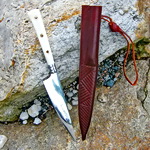 In our medieval shop you can buy faithfully crafted reproductions of medieval knives, detailed made according to historical finds from the high and late Middle Ages with handles made of horn, bone or wood. Our medieval knives enchant simply with their timelessly beautiful shape and are ideally suited for authentic equipment in medieval re-enactment. Our medieval knives are forged by hand and are fitted with a matching leather sheath that, like the medieval originals. We are certain that you will find a matching medieval knife for your historical representation.


